

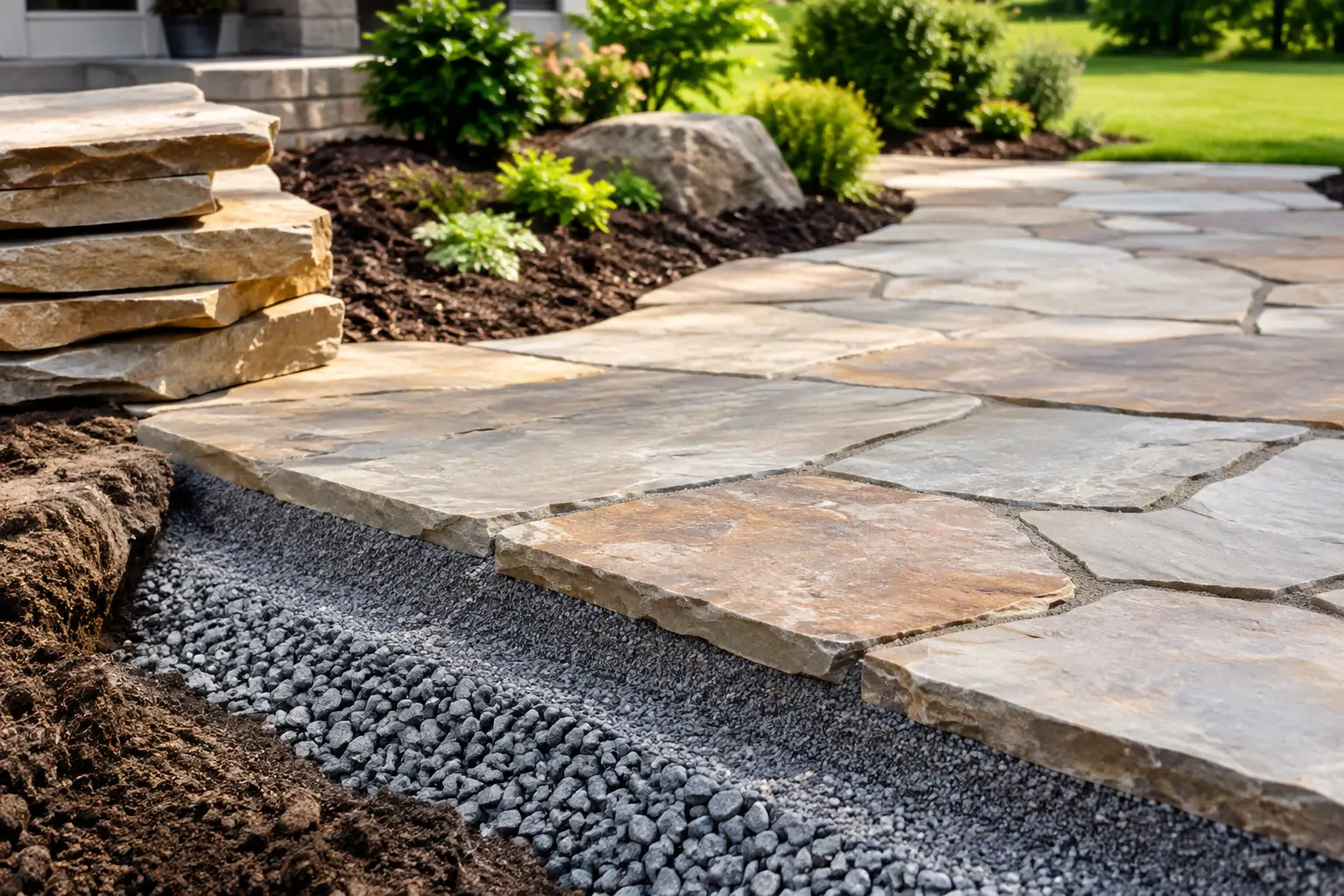
A flagstone patio can look natural and settled-in from the first day, but what sits beneath each stone determines whether it still looks that way a few seasons later. The best base for flagstone is usually a properly compacted layer of crushed stone topped with a thin leveling layer of sand or screenings. That combination gives the patio strength, drainage, and the small amount of adjustability needed to set irregular natural stone flat.
For Birmingham-area homeowners and landscape crews, the base deserves extra attention. Our clay-heavy soils can hold moisture, and summer downpours can expose shortcuts quickly. A beautiful stone surface is only as dependable as the preparation underneath it.
Why a Flagstone Base Matters
Flagstone is not manufactured in perfectly uniform pieces. Its varied thickness, natural edges, and broad surfaces are part of its appeal, but they also make installation different from laying concrete pavers. Each piece needs steady support across its underside. If a stone rests on a few high points or soft soil, it can rock, settle, or crack under foot traffic.
A good base does three jobs at once. It spreads weight over the soil below, allows water to move away instead of collecting under the stone, and provides a level, workable surface for fitting each flagstone. Skipping the base may save labor at the beginning, but it often leads to uneven joints, standing water, and stones that shift after a hard rain.
The right depth depends on the project. A lightly used garden path does not need the same construction as a large patio with a grill, dining table, and regular gatherings. Soil conditions, slope, drainage, and whether vehicles will cross the area also change the answer.
The Best Base for Flagstone: Crushed Stone
For most dry-laid flagstone patios and walkways, compactable crushed stone is the best all-around base material. Ask for a crushed aggregate that includes angular stone and fine particles, often called crusher run, dense-grade aggregate, or a compactable base. The exact name varies, but the goal is the same: a material with mixed particle sizes that locks together when compacted.
Unlike rounded pea gravel, crushed stone has sharp, irregular edges. Those edges interlock under compaction, creating a firm layer that resists movement. The smaller fines fill gaps between larger pieces, helping make the base solid while still allowing water to filter through when it is installed correctly.
For a typical pedestrian patio or walkway, plan on 4 to 6 inches of compacted crushed stone. That means ordering enough material for a deeper loose layer, since aggregate compresses during installation. On weak, wet, or recently disturbed soil, a 6-inch compacted base is the safer choice. Areas that will receive heavier use may need more excavation and a thicker aggregate section.
A local material yard can help translate your square footage and planned depth into the right number of bulk yards. That is often more practical than trying to make repeated bagged-material trips for a patio-sized project.
Why Sand Alone Usually Falls Short
Sand has a place in many flagstone installations, but it is rarely the full answer for a durable base. A patio laid directly on several inches of sand may be easy to level initially, yet sand can wash, shift, and develop low spots when the soil beneath it moves. It also does little to stabilize a soft subgrade.
Use coarse concrete sand or stone screenings as a thin bedding layer over the compacted stone base. Keep that layer around 1 inch thick, or just thick enough to make final adjustments. The crushed stone provides the structure. The bedding layer helps the installer seat stones at a consistent finished height.
Fine masonry sand can work for joint filling in some dry-laid projects, but it should not be used as a deep structural layer below flagstone. If the site has drainage concerns, a screenings bed or carefully graded coarse sand is generally a better fit than loose, fine sand.
Start With a Stable Subgrade
Before bringing in base material, excavate the area to the needed depth. Account for the flagstone thickness, the 1-inch bedding layer, and the 4 to 6 inches of compacted crushed stone. Many flagstones are 1 to 2 inches thick, though natural material varies, so check the pieces you plan to use before setting final grades.
Remove roots, loose topsoil, organic material, and soft pockets. Topsoil is excellent in a garden bed, but it is not a stable foundation for stone. If the exposed soil feels wet, spongy, or especially clay-heavy, dig out weak material until you reach firmer ground where practical.
A woven landscape fabric can be useful between the soil and aggregate, particularly on soft clay or areas where base stone may work down into the subgrade. It helps separate materials without stopping drainage. Do not confuse it with solid plastic sheeting. Plastic can trap water below the patio, which is the opposite of what a flagstone base needs.
Shape the excavated area with a gentle slope away from the home, usually about 1/8 to 1/4 inch per foot. The finished flagstone surface should follow that slope. Water should have a clear route away from foundations, door thresholds, and areas where it could collect against the house.
Build the Base in Compactable Lifts
The method matters as much as the material. Do not spread 6 inches of crushed stone and compact only the top. A plate compactor has limited depth of influence, so build the base in layers, commonly called lifts.
Spread about 2 to 3 inches of crushed stone, wet it lightly if the material is very dry and dusty, then compact it thoroughly with a plate compactor. Repeat until you reach the required compacted depth. A hand tamper can be suitable for a small stepping-stone path, but a mechanical compactor is the better choice for patios and larger walkways.
Check the grade as you go rather than waiting until the end. A long straight board, string line, or level helps catch dips and high spots before the flagstone is installed. Once the base is dense and properly sloped, screed the thin bedding layer and begin placing stone.
Set larger, thicker pieces first and work from a stable edge. Tap each flagstone into place with a rubber mallet, checking that it does not wobble. The finished surface should feel comfortable to walk on, with no abrupt edges that catch a toe. For most patios, keep joints consistent enough to look intentional while allowing the natural shapes of the stone to lead the layout.
When a Different Base Makes Sense
Crushed stone and a bedding layer are the standard for dry-laid patios, but not every flagstone project is dry-laid. Mortared flagstone over a concrete slab is a separate system. The concrete needs its own properly compacted aggregate base, reinforcement, drainage plan, and control joints before stone is installed with mortar. Putting mortar over an unstable base simply hides the problem until cracking appears.
For individual stepping stones in a lawn or informal garden path, a full 4- to 6-inch base may be more than the project requires. Each stone can be set into a carefully excavated pocket with compacted crushed stone below it. The same principles still apply: remove soft soil, compact the support layer, and set the top of the stone at a safe walking height.
If you are creating a path where joints will be planted with creeping groundcover, do not fill the joints with concrete or mortar. Use a stable crushed-stone base beneath the stones, then leave enough joint space for soil and plants. Expect more ongoing maintenance than a sand-filled or polymeric-sand joint, especially during Birmingham’s growing season.
Common Base Mistakes to Avoid
The most common problem is laying flagstone directly over soil. Even well-packed soil changes with moisture, roots, and seasonal movement. Another is using rounded gravel as the main base. It drains, but its smooth pieces roll against one another instead of locking together.
Also avoid making the bedding sand too deep. A thick layer may feel forgiving while you are setting stones, but it allows movement later. Keep sand or screenings thin and let compacted aggregate do the heavy lifting.
Finally, do not ignore drainage because the patio looks level. Water always finds the low point. A subtle, planned slope will be nearly invisible from a chair on the patio, but it can prevent major trouble around the home.
For dependable results, choose clean, compactable aggregate, build it in layers, and give water somewhere to go. Landscape Source can help Birmingham homeowners and crews get the bulk stone and sand needed for the project, with delivery arranged where it is most useful on the property. A carefully built base may never be seen, but it is what lets the finished flagstone look natural, feel solid, and stay welcoming year after year.

Leave a Reply