

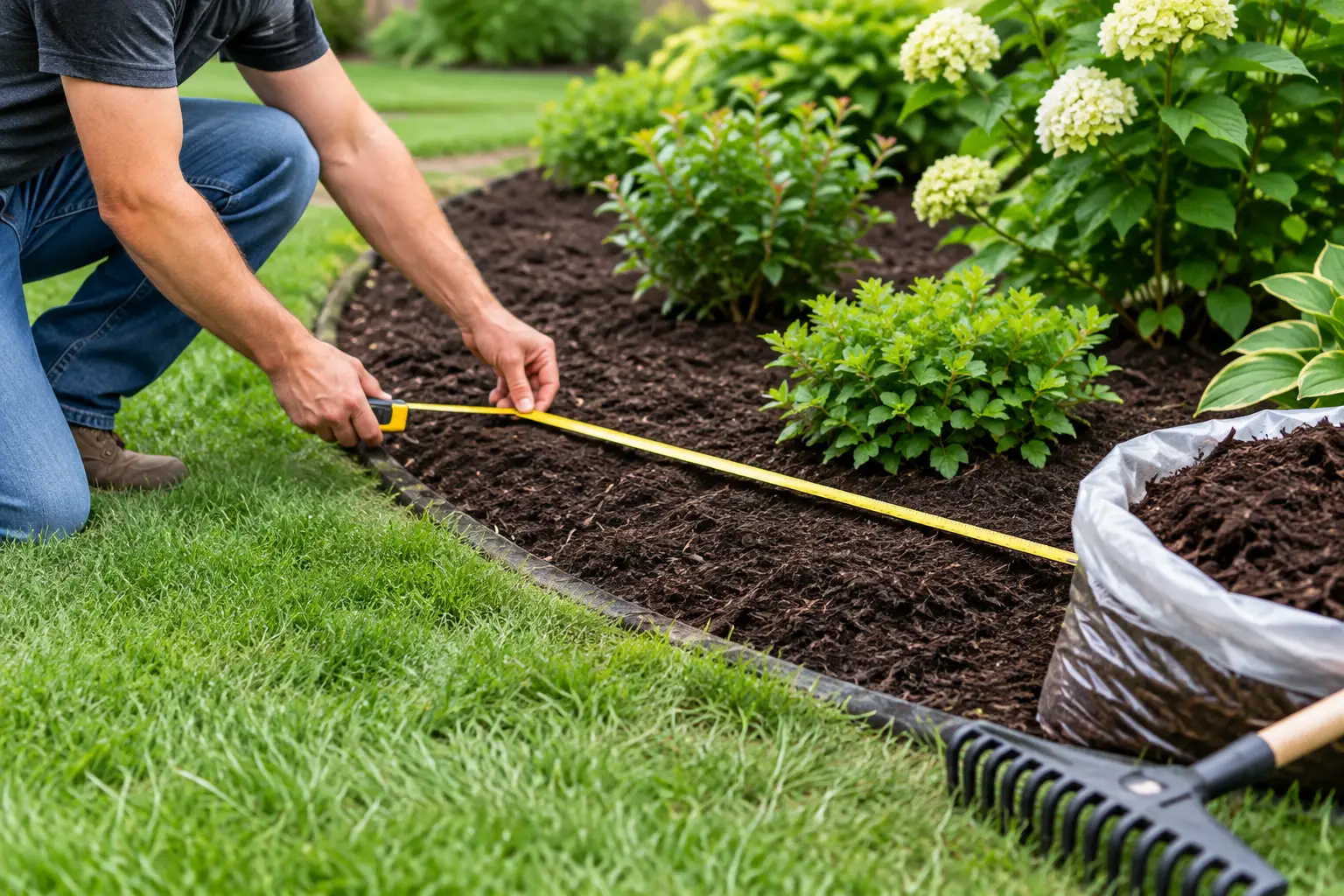
A fresh layer of mulch can make a Birmingham landscape look finished in an afternoon, but ordering the wrong amount can slow the job down. If you need to calculate mulch yardage, you only need three measurements: the length of the bed, its width, and the depth of mulch you want. A quick calculation gives you a dependable starting point for pickup or delivery, whether you are refreshing a small front bed or covering an entire property.
The Simple Formula to Calculate Mulch Yardage
Bulk mulch is sold by the cubic yard. One cubic yard covers 324 square feet at 1 inch deep, 162 square feet at 2 inches deep, 108 square feet at 3 inches deep, or 81 square feet at 4 inches deep.
For most projects, use this formula:
Length in feet × width in feet × mulch depth in inches ÷ 324 = cubic yards needed
For example, say a rectangular planting bed is 20 feet long and 10 feet wide. You want a 3-inch layer of mulch:
20 × 10 × 3 ÷ 324 = 1.85 cubic yards
In that case, ordering 2 cubic yards is the practical choice. It gives you enough material to cover the whole bed evenly and allows for the irregular edges, low spots, and slight variations that show up in nearly every landscape bed.
The formula works because it converts your bed’s square footage and desired depth into cubic yards. It is much more accurate than guessing from the size of a pile or trying to convert from bagged mulch at the store.
Start by Measuring the Area
Measure the longest length and widest width of each bed in feet. A tape measure works well for small spaces. For larger areas, a measuring wheel can save time, especially along long foundation beds, fence lines, or commercial properties.
If a bed is a simple rectangle, multiply length by width to get square footage. A 12-foot by 8-foot bed is 96 square feet. Write each area down separately before adding them together. This is especially helpful when your front yard has several islands, tree rings, and borders that all need mulch.
For a circular tree ring, measure from one side straight across the center to get the diameter. Divide the diameter by two, then multiply that number by itself and multiply by 3.14. The result is the square footage.
For instance, a tree ring with a 10-foot diameter has a radius of 5 feet. Multiply 5 × 5 × 3.14 for about 78.5 square feet. At 3 inches deep, that area needs roughly 0.73 cubic yards of mulch. If you are mulching several trees, add each ring to the rest of your total.
Break Curved Beds Into Manageable Shapes
Most garden beds are not perfect rectangles, and that is fine. Curved borders, kidney-shaped islands, and beds that widen near a driveway can be estimated by breaking them into smaller, familiar shapes.
A curved bed may have one rectangular center section, a triangular end, and a rounded edge. Calculate each section as closely as you can, then add the square footage together. For a triangular section, multiply the base by the height and divide by two.
You do not need survey-level precision for mulch. The goal is to order enough quality material to maintain a consistent finished depth. For unusually curved beds, measuring the overall length and using the average width is often a reliable shortcut. Add a small allowance afterward rather than trying to account for every inch of the edge.
Choose the Right Mulch Depth
Depth changes your yardage more than most homeowners expect. A 2-inch layer and a 3-inch layer may look similar on paper, but the 3-inch layer requires 50 percent more mulch.
For established landscape beds, 2 to 3 inches is usually a good working depth. It gives the bed a clean appearance, helps hold moisture, and provides a useful barrier against weeds without burying plants too deeply. A newly prepared bed with bare soil may benefit from a full 3 inches. If the area has an existing, healthy mulch layer, you may only need enough to refresh the color and restore the depth.
Avoid piling mulch too high against trunks, shrubs, or the crowns of perennials. Keep a small open space around the base of plants so moisture does not stay trapped against bark and stems. Mulch should look like a smooth blanket across the bed, not a mound around each plant.
Four inches can be appropriate in certain large natural areas or where a deeper layer is specifically needed, but it is not automatically better. In many ornamental beds, extra depth can limit air movement to the soil and create problems around shallow-rooted plants. If you are unsure, a 3-inch target is a dependable place to start.
Adjust Your Order for Real-World Conditions
The calculated number is your base amount, not always your final order. Beds have uneven ground, roots, edging, corners, and plant clusters that make exact coverage difficult. Adding 5 to 10 percent is sensible for most residential projects, particularly when beds have curves or you want a consistent finished appearance.
Round up when your calculation lands close to a half-yard or full-yard delivery quantity. Running short can leave a project unfinished, and a second delivery may cost more time and money than a small amount of extra mulch. On the other hand, do not add a full extra yard to a tiny project unless you have another area ready for it. Mulch stored in a pile for too long can be inconvenient to move later.
Also consider what is already in the bed. If you are topping off existing mulch, check its actual depth in several places. A bed that still has 2 inches of material does not need another full 3 inches. You may only need a 1-inch refresh, which cuts the required volume substantially.
In Birmingham’s warm, wet seasons, mulch can gradually break down and blend into the soil. That is useful for soil health, but it also means depth can vary from one part of the bed to another. Measure in a few spots before ordering, especially in older beds that have not been refreshed recently.
A Practical Yardage Example for a Front Yard
Suppose you have three areas to mulch: a 24-foot by 6-foot foundation bed, a 15-foot by 8-foot island bed, and two 8-foot-diameter tree rings. You want a 3-inch layer.
The foundation bed is 144 square feet. The island bed is 120 square feet. Each tree ring is about 50 square feet, so both rings equal about 100 square feet. Together, the project covers 364 square feet.
Multiply 364 square feet by 3 inches, then divide by 324. The result is 3.37 cubic yards. With curved bed edges and routine variation in depth, ordering 3.5 to 4 cubic yards makes sense. If the existing mulch is still fairly deep, 3.5 yards may be enough. If the soil is mostly bare or the beds are uneven, 4 yards provides a better margin.
Bulk Mulch Makes Larger Jobs Easier
Bagged mulch can be convenient for a small touch-up, but bulk mulch is often the more practical choice when you are covering multiple beds or installing a new landscape. A cubic yard is equal to 27 cubic feet, so even a modest 3-yard project represents a significant number of bags.
Bulk ordering also lets you focus on the material itself: color, texture, coverage, and where the load needs to go. When scheduling delivery, think ahead about access and placement. A driveway drop is often the easiest option, but a clear, specific placement request can make wheelbarrow work shorter and keep materials out of the way of vehicles or walkways.
Landscape Source Inc. helps homeowners and landscape crews throughout the Birmingham area get the right amount of quality bulk mulch without making the order more complicated than it needs to be. Bring your measurements, bed dimensions, and preferred depth to the yard or have them ready when arranging delivery. A little planning at the start means you can spend the day spreading mulch, not making an extra trip for more.

Leave a Reply